

USCIS Says Adjustment of Status Is Now an "Extraordinary" Favor. The Statute, the Regulations, and the Agency's Own Policy Manual Say Otherwise.
A new policy memo seeks to rewrite U.S. immigration law without undergoing rulemaking. What it actually does, what it cannot legally do & what it means for pending applications.

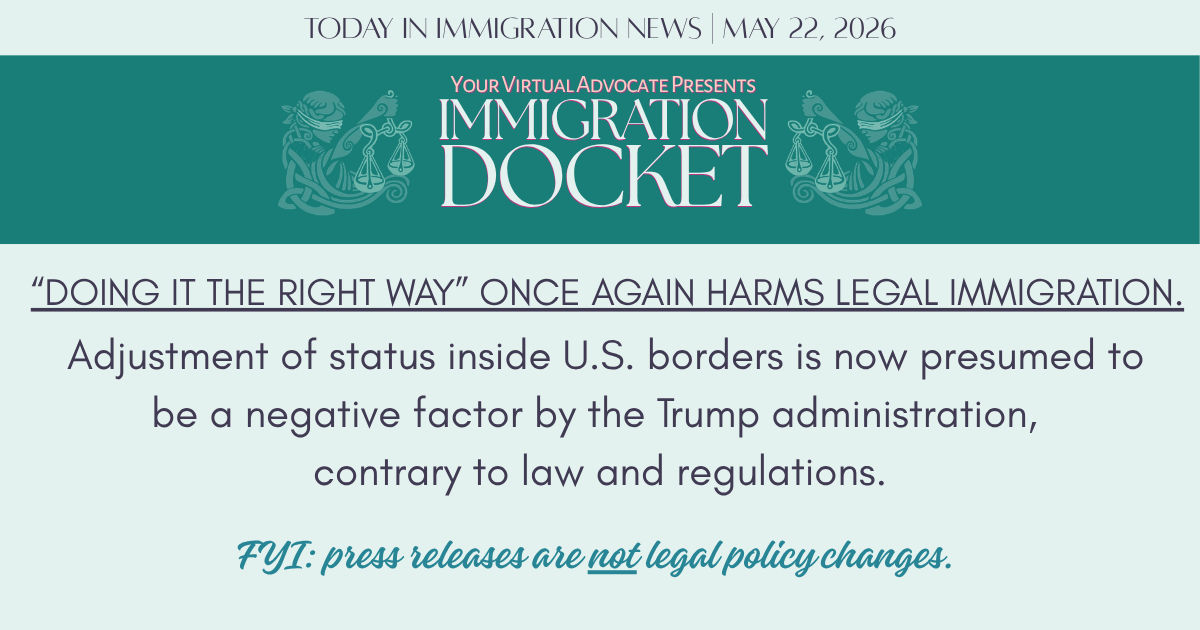
What Happened
On May 21, 2026, USCIS issued Policy Memorandum PM-602-0199, titled “Adjustment of Status is a Matter of Discretion and Administrative Grace, and an Extraordinary Relief that Permits Applicants to Dispense with the Ordinary Consular Visa Process.”
The accompanying
press release goes further than the memo itself. It tells the public:
From now on, an alien who is in the U.S. temporarily and wants a Green Card must return to their home country to apply, except in extraordinary circumstances.
That sentence is doing a lot of work. It is also not what the underlying statute says, not what the regulations say, and not what the memo itself, read carefully, actually authorizes.
This post walks through the gap between the press release and the law, and what that gap means in practice.
TL:DR
The press release overshoots the memo. The memo does not eliminate adjustment of status. It does not rewrite eligibility rules. It tells officers to weigh discretion more heavily against applicants and to treat the existence of consular processing as itself an adverse factor.
The framing is legally vulnerable. Treating adjustment as a near-presumptive denial conflicts with the statute (INA § 245(a)), with binding regulations (8 CFR Part 245), with the USCIS Policy Manual, and with decades of case-by-case adjudication practice.
A real change of this scope requires notice-and-comment rulemaking under the Administrative Procedure Act. A policy memo cannot do it.
For people with pending I-485s, do not leave the country. Departure without advance parole is regulatory abandonment of the application, and the press release inviting applicants to “return to their home country” is, for most pending applicants, a direct invitation to lose their case.
Dual-intent visa holders and long-resident nonimmigrants are squarely in the crosshairs of how this memo will be applied, even though they are exactly the group Congress designed the adjustment for.
Section 1: What the Memo Actually Says (and Doesn’t Say)
The memo’s stated purpose is to “remind” officers that adjustment of status is “a matter of discretion and administrative grace” and an “extraordinary” form of relief. It cites Matter of Blas, 15 I&N Dec. 626 (BIA 1974), and a string of Supreme Court and circuit court decisions for the proposition that adjustment is a matter of grace, not entitlement.
That part is not new. It has been the law since the 1970s.
What is new is the framing the memo bolts on top of that doctrine:
Adjustment exists to let applicants “dispense with” the ordinary consular process.
Nonimmigrant admission and parole come with an expectation of departure.
A nonimmigrant’s attempt to adjust status, instead of leaving and consular processing, is itself “a contravention of Congressional expectations” and an “adverse factor.”
Absence of negatives is not enough. Applicants must show “unusual or even outstanding equities.”
In plain language: the memo instructs officers to start the discretionary analysis from a presumption that adjustment is disfavored, and that the applicant’s choice to file in the U.S. rather than depart and consular process is itself a reason to deny.
That is a substantive change in how discretion is exercised, even though the memo is careful never to say so directly.
What the memo does NOT do
It does not change eligibility under INA § 245(a) or § 245(c).
It does not say adjustment is unavailable for any specific category.
It does not eliminate dual intent for H-1B, L-1, O-1, or other dual-intent classifications.
It does not change the regulations at 8 CFR Part 245.
It does not, on its face, override the USCIS Policy Manual.
It explicitly states it “may not be relied upon to create any right or benefit, substantive or procedural, enforceable under law.”
That last point cuts both ways. The agency is saying the memo binds no one — but it is being used as cover for press messaging that very clearly tells the public the rules have changed.
Section 2: Practical Guidance by Group
If you have a pending I-485
Do not leave the United States without advance parole. This is the most urgent point in the entire post.
Under 8 CFR § 245.2(a)(4)(ii)(A), the departure of an adjustment applicant who is not in removal proceedings is “deemed an abandonment of the application.” Departure without an Advance Parole document, or for H-1/H-4 and L-1/L-2 holders without a maintained valid status under the limited exception at 8 CFR § 245.2(a)(4)(ii)(C), terminates the pending application.
The press release tells you to “return to your home country.” The regulation says doing that ends your case. Both cannot be right.
Consult with your immigration attorney before you take next steps.
Other practical points:
Keep maintaining your underlying status if you have one.
Continue to comply with employment authorization conditions if you are working on a pending I-485 EAD.
Document equities aggressively now that include family ties, employment, community involvement, tax compliance, length of residence, and any factors that would qualify as “unusual or outstanding.”
Anticipate longer adjudications and more Requests for Evidence focused on discretionary factors.
If you are considering filing AOS now
The eligibility rules have not changed. INA § 245(a) still allows adjustment for applicants who were inspected and admitted or paroled, are admissible, and have an immediately available immigrant visa. INA § 245(c) bars still apply, and the existing exceptions (immediate relatives, § 245(i), § 245(k) for employment-based, VAWA, etc.) still apply.
Before filing, weigh three questions:
Are you in a strong discretionary posture? Long-standing presence, family ties to U.S. citizens or LPRs, clean record, consistent status maintenance, tax compliance.
Is consular processing actually a worse option in your situation? For some applicants, particularly those with potential inadmissibility issues that would trigger 3- or 10-year bars upon departure, or those with complex travel histories, adjustment remains the only safe path.
Can you wait for the inevitable litigation to play out? Filing now means being adjudicated under this memo’s framing. Some applicants may have flexibility on timing.
If you are an H-1B, L-1, or other dual-intent holder
The memo includes a critical concession buried in the analysis:
“USCIS reminds its officers that applying for adjustment of status is not inconsistent with simultaneously maintaining nonimmigrant status in a category with dual intent.”
It then adds the limiting principle:
“However, maintaining lawful status in a dual intent nonimmigrant category is not sufficient, on its own, to warrant a favorable exercise of discretion.”
In plain language: dual intent still protects you from being treated as having lied about your intent. But the memo signals that officers should not automatically grant discretionary credit to a dual-intent nonimmigrant who follows the rules.
For H-1B and L-1 workers with pending or contemplated I-485s, this means:
The pathway is intact.
The discretionary analysis just got harder.
Documenting equities such as U.S. citizen or LPR family members, length of contribution, employer support, and community ties matters more than ever.
If you are an employment-based AOS applicant
INA § 245(k), the provision that forgives certain status and unauthorized employment violations for employment-based applicants, is statutory. A policy memo cannot override it.
But the memo’s framing creates pressure on the discretionary side of EB adjudications. Expect:
More scrutiny of any gaps in status, even forgiven ones.
More questions about the timing of filing.
Discretionary denials in cases that would previously have been routine approvals.
If you are a student (F-1) who has been in the U.S. for years
This is one of the groups most exposed by the memo’s logic. F-1 is not a dual-intent classification. Years of presence on a nonimmigrant visa, followed by an adjustment filing through marriage to a U.S. citizen or an employer-based path, is exactly the fact pattern the memo characterizes as “contravention” of congressional expectations.
If you are in this group, the eligibility framework has not changed, but you should expect officers to weigh your long F-1 history against you as an alleged signal of “intent to remain.” Documentation of your good-faith student status throughout your years here will matter.
Section 3: The Legal Problems With This Memo
This is where the gap between the press release and the law becomes a litigation roadmap. The memo’s framing collides with at least four bodies of authority.
1. The statute (INA § 245(a))
Section 245(a) of the INA reads, in relevant part, that the status of an alien “may be adjusted by the Attorney General [now the Secretary of Homeland Security], in his discretion and under such regulations as he may prescribe.”
Congress created this pathway deliberately. It expanded it through §245(i), §245(k), VAWA, and the trafficking and crime victim provisions of §245(l) and §245(m). The statute does not characterize adjustment as a deviation from a default consular process. It treats it as a parallel pathway for people physically present in the United States.
The memo’s repeated framing of adjustment as something that “permits the alien applicant to avoid the prescribed, ordinary consular visa process” is editorial. The statute prescribes both processes. Neither is more “ordinary” than the other in the statutory text.
2. The regulations (8 CFR Part 245)
This is the strongest legal problem with the press release messaging.
8 CFR §245.2 governs the application process and explicitly contemplates pending applications, including:
Departure of an applicant not in removal proceedings is abandonment unless the applicant has advance parole (§ 245.2(a)(4)(ii)(A))
A limited exception for H-1/H-4 and L-1/L-2 nonimmigrants who maintain valid status (§ 245.2(a)(4)(ii)(C))
Procedures for renewal of denied applications in removal proceedings
Treatment of unauthorized employment during pendency under § 274a.12(c)(9)
These regulations were promulgated through notice-and-comment rulemaking. They establish the framework for pending applications. The press release’s “return to your home country” message conflicts directly with the abandonment rule telling applicants to do precisely what the regulation says will terminate their cases.
A policy memo cannot override duly promulgated regulations. Under United States v. Nixon, 418 U.S. 683 (1974), and a long line of administrative law, an agency must follow its own regulations until it changes them through proper procedure.
3. The USCIS Policy Manual
The memo cites the USCIS Policy Manual, Volume 7, Part A, Chapter 10 (”Legal Analysis and Use of Discretion”) as the existing guidance officers are to consider. That chapter, which has not been formally amended by this memo, directs adjudicators to:
Weigh positive and negative factors in totality.
Treat positive factors (family ties, length of residence, employment history, community ties, tax compliance, hardship) as substantively meaningful.
Apply Matter of Mendez-Moralez, 21 I&N Dec. 296 (BIA 1996), as a balancing standard, not a thumb on the scale.
The memo grafts a new framing on top of this Policy Manual chapter without rewriting it. Adjudicators are now told to read the Policy Manual through a lens that treats the act of filing AOS itself as adverse. That is internally inconsistent guidance, and it sets up appellate challenges in every denied case.
4. The Administrative Procedure Act
This is the doctrinal heart of the legal vulnerability.
The APA, at 5 U.S.C. § 553, requires notice-and-comment rulemaking for substantive rules. The exception for “interpretative rules, general statements of policy, or rules of agency organization, procedure, or practice” is narrow.
Under the D.C. Circuit’s framework, an agency action requires notice-and-comment if it (1) alters the rights or interests of parties, (2) makes a substantive change to the regulatory regime, and (3) has present binding effect. See Electronic Privacy Information Center v. U.S. Department of Homeland Security, 653 F.3d 1 (D.C. Cir. 2011).
This memo, paired with its public messaging, looks like it satisfies all three:
Alters rights or interests: Applicants who would previously have received favorable discretion in routine cases will now face heightened scrutiny and likely denial.
Substantive change: Treating the filing of AOS itself as an adverse discretionary factor is a substantive shift from the Mendez-Moralez totality-of-the-circumstances framework.
Present binding effect: The memo directs officers to apply this framing. The press release tells the public the rules have changed.
The agency’s standard disclaimer language, that the memo “may not be relied upon to create any right or benefit”, does not insulate it from APA challenge. The D.C. Circuit has repeatedly rejected the argument that agency self-labeling controls. What matters is whether the agency action functions as a substantive rule.
If the agency wants to fundamentally restructure adjustment of status discretion, it has to do so by notice-and-comment rulemaking, with all the procedural protections that entails including public comment, reasoned response, and a final rule subject to APA review.
Section 4: What to Watch For
A few signals will tell us how this plays out:
Denial rates. If routine I-485 denials spike, particularly for dual-intent nonimmigrants and long-resident applicants, that is evidence the memo is operating as a substantive rule.
Denial notice language. The memo requires officers to articulate the positive and negative factors in any discretionary denial. Sampling those notices will reveal whether officers are treating “the choice to file AOS” itself as a negative factor.
Litigation. Expect challenges from AILA, the ACLU, state attorneys general, and individual applicants. Watch for APA notice-and-comment challenges, regulatory conflict claims, and as-applied challenges in individual cases.
Subcategory guidance. The memo signals that USCIS “may provide policy guidance specific to certain adjustment of status categories or discrete populations.” That is the agency telegraphing that more memos will come, targeted at specific groups. Each one will be its own legal flashpoint.
The Policy Manual. If USCIS amends Volume 7, Part A, Chapter 10 to formally incorporate this framing, the legal posture shifts. Until then, the memo is sitting on top of unchanged regulations and unchanged Policy Manual guidance.
Section 5: The Pattern
This memo fits a recognizable pattern: an agency uses guidance documents to do what it would have to do by rulemaking, then relies on the friction of litigation, the cost of challenge, and the chilling effect on applicants to achieve the policy outcome regardless of legality.
The chilling effect is the point. If applicants believe adjustment has become a near-presumptive denial, fewer will file. If pending applicants believe they should “return home,” some will leave and abandon their cases. The policy goal is achieved by deterrence, not adjudication.
The statute has not changed. The regulations have not changed. The Policy Manual has not changed. The case law cited in the memo, Blas, Mendez-Moralez, Patel v. Garland — has not changed.
What has changed is the messaging, and the framing officers are told to apply when exercising discretion. That is a substantive shift dressed in interpretive clothing.
It will be tested in court. In the meantime, the people most affected are those with the least margin for error: pending applicants, long-resident nonimmigrants, and dual-intent workers whose lives are built around the legal framework in place yesterday.
Immigration Docket tracks the gap between what immigration agencies announce and what they can legally do. Subscribe for ongoing coverage of PM-602-0199 and the litigation that follows.