The Trump Gold Card
Buying extraordinary ability with extraordinary wealth


On December 10, 2025, the Trump administration unveiled an new immigration mechanism: the Trump Gold Card Program, introduced under Executive Order 14351 earlier this year. The program allows foreign nationals to bypass the traditional evidentiary requirements of the EB-1A and EB-2 National Interest Waiver (NIW) categories by making a substantial financial “gift” to the U.S. government.
What is currently a process bogged down by burdensome Requests for Evidence (RFEs) and unpredictable final merits denials for many extraordinarily qualified foreign nationals may now be fast-tracked—not with more evidence, but with more money.
What Is the Trump Gold Card Program?
The Trump Gold Card is not a new immigrant visa category. It is a new petition pathway via two existing ones:
EB-1A (Extraordinary Ability – INA §203(b)(1)(A)), and
EB-2 NIW (National Interest Waiver – INA §203(b)(2)(B))
Applicants use a new form, I-140G, to file their petition without submitting evidence of merit or field acclaim, as required under the normal EB-1A or NIW standards. Instead, petitioners:
Select one of the two classifications (EB-1A or EB-2 NIW),
Submit Form I-140G electronically,
Pay a non-refundable $15,000 filing fee, and
Make an unrestricted gift to the U.S. Department of Commerce:
$1 million for self-petitioners
$2 million if filed by a sponsoring corporation or entity
What Does the Applicant Need to Prove?
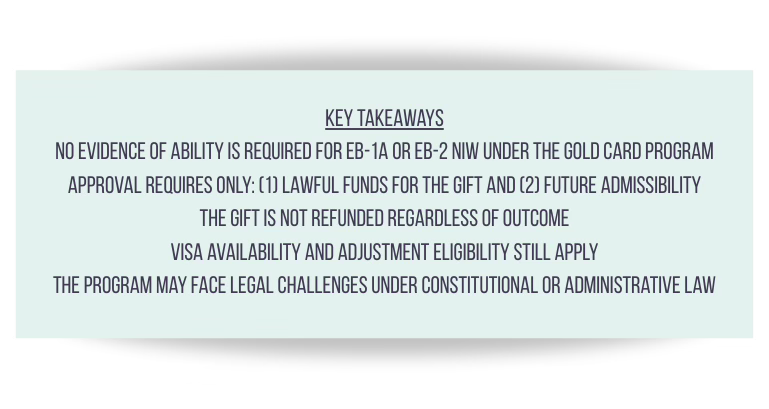
TL;DR – Nothing. The instructions claim a rigorous background check will be conducted. However, we have repeatedly seen this administration prioritize money over security. Expect “ability for the cash to clear the bank” to be the only requirement.
Notwithstanding what we expect to be the practice, there are two eligibility requirements stated in the official Form I-140G and its instructions:
That the funds used for the gift were obtained lawfully, and
That the beneficiary is admissible for permanent residency under existing INA provisions when the time comes to adjust status or pursue consular processing.
There is no requirement that the petitioner:
Submit evidence of extraordinary ability (for EB-1A),
Satisfy the three-prong Dhanasar framework (for NIW),
Submit publications, letters of recommendation, media, judging history, or comparable evidence or anything else required of the typical applicant for the EB-1A or EB-2 NIW classifications.
Even for EB-2 NIW cases, the only technical requirement is submission of an uncertified ETA-9089 (PERM form)—a procedural placeholder rather than a labor certification or evidentiary hurdle. It remains unclear whether this is a genuine requirement or an error in the form instructions, given the absence of evidentiary requirements for the employment-based visa classification.
The Gold Card program ultimately replaces evidentiary merit with financial contribution. It monetizes access to the I-140 approval process while retaining standard adjustment eligibility rules.
What Happens After I-140G Approval?
Approval of a Gold Card petition does not allegedly guarantee a green card. The beneficiary must still:
Wait for a current priority date (as listed in the Department of State’s Visa Bulletin),
Be eligible to adjust status (in the U.S.) or complete consular processing abroad,
Demonstrate they are not inadmissible under INA §212 (e.g., no grounds of fraud, criminal bars, public charge, etc.).
Applicants from retrogressed countries (e.g., India or China under EB-2) will still experience delays due to visa availability, unless the allocation of visa numbers is changed.
Is This Legal Without Congress?
That question is likely to be tested. The program walks a fine line between executive discretion and overreach.
The administration will likely argue this is legal because:
The INA gives the executive branch discretion over immigration petition procedures.
No new visa categories are created; it simply alters how a person can petition for a preexisting classification.
The gift is not a “fee” or “payment for benefit” under existing regulations.
The President claims to have unlimited authority in all actions and things he deems to be legal.
Reasons this new visa scheme may not be legal:
The lack of evidentiary review raises due process and equal protection concerns—particularly for otherwise qualified individuals without the means to pay.
Conditioning access to immigration benefits on a financial donation may violate the Appropriations Clause or raise anti-corruption concerns.
Courts may find this an ultra vires executive action, particularly post-Loper Bright (which curtailed Chevron deference).
The program runs contrary to congressional intent when creating these pathways for individuals of extraordinary ability and whose contributions are in the national Interest.
Even if facially lawful, the optics of “green cards for sale” may invite congressional hearings, litigation, or agency challenges.
Does It Undermine the Meaning of Merit-Based Immigration?
For years, highly qualified individuals, including scientists, artists, engineers, and policy experts, have seen their EB-1A and NIW petitions denied not because they lacked merit, but because of inconsistent adjudications, AI-driven RFEs, or shifting internal guidance. The Gold Card offers a path free of those barriers.
Yet, by eliminating merit-based review, the program effectively turns extraordinary ability into extraordinary liquidity.
The system no longer assesses whether you’re at the top of your field or of importance to the U.S. as a nation.
It only asks: Can you afford to donate a million dollars?
Final Thoughts
The Trump Gold Card could reshape how elite global talent (and wealth) interact with U.S. immigration. It offers a fast track to approval, but not necessarily to a green card, without the evidentiary battles that have come to define EB-1A and NIW adjudication.
This is a grift that undermines much-needed top talent for the United States. This does not make America great. It diminishes the United States’ ability to compete globally for STEM and other top talent. Truly qualified top talent must fight hard with the government for these approvals, then wait for the paltry number of visas to become available to complete their path. These are people who have spent years studying in the United States, advancing critical technologies and research, building exceptional companies, and becoming top experts in fields where the U.S. has a shortage of advanced skills.
Now, instead, an extraordinary wallet means more than extraordinary talents.
Whether this is a temporary relief mechanism, a constitutional time bomb, or a long-term shift in how the U.S. defines merit remains to be seen. Whatever the case, it reflects a new era of immigration strategy—where procedural efficiency is no longer earned, but bought.